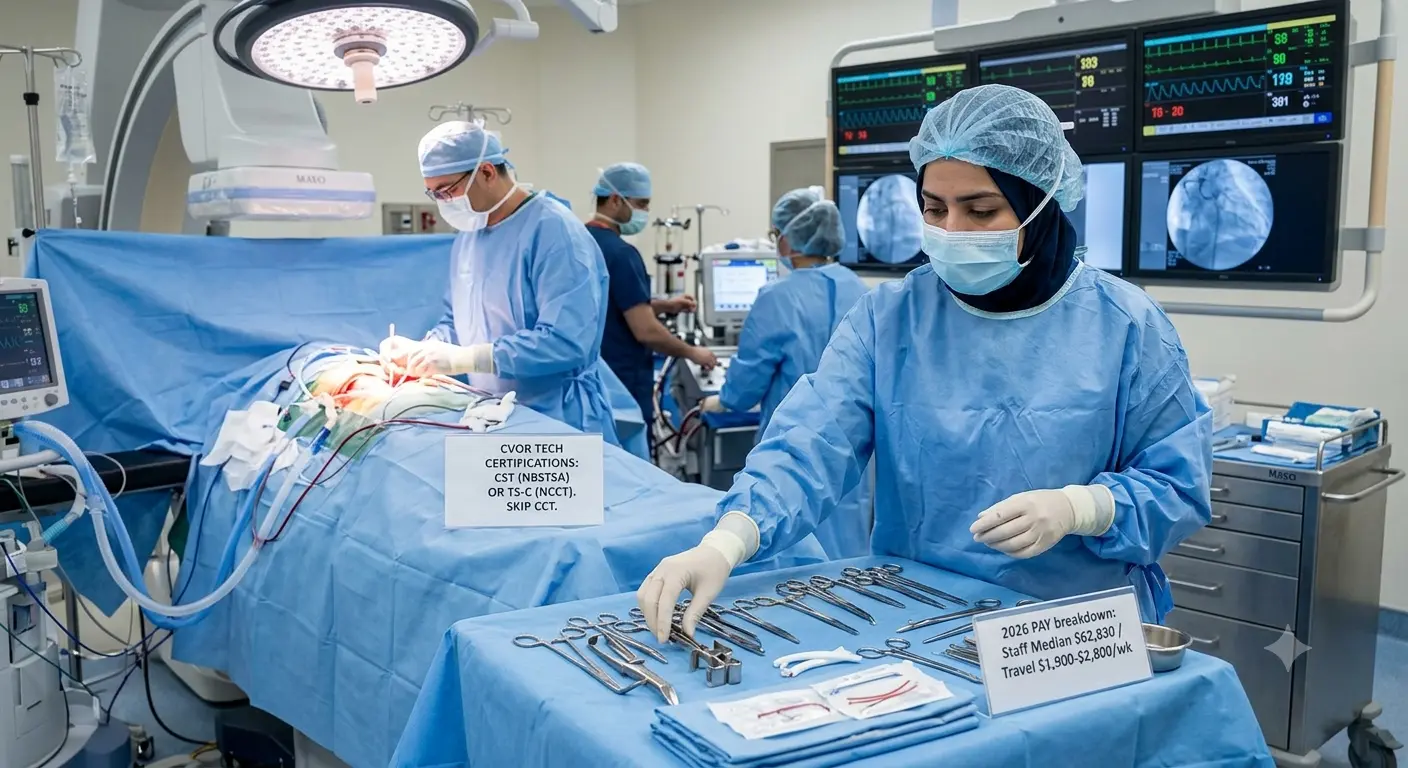
CVOR Tech Careers: What the Job Really Pays and Requires in 2026
A CVOR tech, short for cardiovascular operating room technician, is a surgical technologist who assists surgeons during heart and blood vessel procedures. They prepare instruments, keep the operating room sterile, and support the surgical team from the first incision through recovery.
If you have been researching this career, you have probably already run into some confusing and contradictory information about certification and pay. Let’s clear that up.
What Does the Job Actually Involve?
Day to day, the role handles a specific set of responsibilities before, during, and after surgery.
Before the procedure, they focus on:
- Sterilizing instruments and preparing the operating room
- Reviewing physician preference cards for the specific surgery
- Positioning the patient and prepping the sterile field
During surgery, their job shifts to:
- Passing instruments to the surgeon
- Maintaining aseptic technique throughout the procedure
- Monitoring vital signs alongside the rest of the team
After surgery wraps up, they handle patient transport to recovery, run surgical counts to confirm nothing was left behind, and reset the room for the next case.
Is a CVOR Tech the Same as a Cardiovascular Technologist?
No, and this mix up trips up a lot of people researching this career. A CVOR tech works in the operating room during surgery. A cardiovascular technologist works in a cardiology suite, running EKG machine readings, stress tests, and imaging on patients who are not having surgery that day.
These are two different careers with two different training paths and two different certifications. If a job description mentions hemodynamic equipment, stress tests, or patient registration in a cardiology suite, that is the diagnostic role, not surgical work.
How Do You Get Started in This Career?
Start with an accredited surgical technology program, most of them accredited through CAAHEP. These programs run anywhere from 9 months to 2 years depending on whether you choose a certificate, diploma, or associate degree, and most combine classroom anatomy and physiology with hands on lab work before you ever touch a real patient.
After finishing your program, you will need clinical rotations to build real hands on experience. Many people start out as general surgical technologists first, then specialize into cardiovascular cases once they have a year or so of experience under their belt. Others move directly into a cardiovascular focused program if one is available nearby, skipping the general rotation entirely.
What Certification Do You Actually Need?
Here is where a lot of guides get this wrong. The two certifications that actually apply here are CST through NBSTSA and TS-C through NCCT.
You will sometimes see CCT through CCI listed as an option for this specialty. That is incorrect. CCT certifies EKG, Holter monitoring, and stress testing skills for a diagnostic role, not surgical skills for the operating room. If you are aiming for the surgical side specifically, skip CCT and go straight for CST or TS-C.
[Comparison Table] Certification Options Compared
| Certification | Issuing Body | Actually For This Role? |
| CST | NBSTSA | Yes, primary credential |
| TS-C | NCCT | Yes, accepted alternative |
| CCT | CCI | No, diagnostic EKG role only |
Requirements also vary by state, so check your specific state board before you commit to a program or exam. A handful of states require NBSTSA certification specifically, at least one state accepts either NBSTSA or another nationally recognized credential, and a few states layer their own licensure requirements on top of national certification. Skipping this check is one of the most common and most expensive mistakes people make early on.
What Procedures Will You Assist With?
Real work in this specialty covers a wide range of cardiac and vascular cases, not just one type of surgery.
Expect to assist with:
- Coronary artery bypass grafting and mitral valve repair
- Heart valve replacement and transcatheter aortic valve replacement
- Left atrial appendage closure and aortic dissection repair
- Circulatory arrest cases and cardiac catheterization
- ECMO, Impella, and balloon pump insertion
- Vascular cases like EVAR and TCAR, plus lead placement
You will also work with equipment like the bypass machine, defibrillators, and EKG machines throughout these procedures. Larger academic centers and Magnet-designated hospitals tend to handle higher case volumes, which means more variety and faster hands-on learning early in your career.
Who Do You Work With in the Operating Room?
You are one part of a bigger team here. In a typical cardiac case, you will work alongside the circulating nurse, scrub nurse, CRNA, and cardiovascular surgeon, plus the wider perioperative team supporting the case from start to finish.
A perfusionist often works the same room too, managing blood circulation and oxygenation through the bypass machine while you focus on instruments and the sterile field. Clear, fast communication between everyone in the room matters more here than in almost any other surgical specialty, since a cardiac case can shift from routine to emergency in seconds.
How Physically Demanding Is the Job?
This work is genuinely physical. Long cardiac cases mean hours of standing in one spot, precise aseptic technique with zero room for error, and real exposure risks that come with any surgical setting, including radiation from imaging equipment and contact with bloodborne pathogens.
Facilities accredited by the Joint Commission hold strict safety standards, which helps, but the fast paced environment and mental focus required for a multi hour open heart case stays intense no matter where you work. Cases can run four, six, sometimes eight hours straight with no real break. If you are considering this path, shadowing a real case before committing to a full program is worth the effort.
How Do You Advance to First Assistant Work?
This career is not a dead end. Advancing to CVOR first assistant work means pursuing a CSFA credential, which typically requires an externship with around 125 logged surgical cases.
This path moves you from indirect support into direct, hands on involvement in the surgery itself, including tasks like suturing and tissue handling, and it comes with a real jump in both pay and responsibility. It is a natural next step once you have a few solid years of experience behind you, and many surgeons actively encourage strong techs to pursue it.
How Much Does This Job Actually Pay?
This is where competitor guides fall apart the most, quoting numbers anywhere from 51,000 dollars to over 160,000 dollars for the same job title with zero explanation. Here is the real breakdown.
Staff pay lands at a national median of 64,650 dollars a year, with a mean of 68,710 dollars, based on BLS data covering surgical technologists broadly. Real job postings show hourly staff pay landing between 24.73 and 35.56 dollars an hour at most hospitals, sometimes higher depending on location and experience.
[Comparison Table] Staff Pay vs Travel Pay
| Pay Type | Range |
| Staff (hourly, real postings) | $24.73 to $35.56 per hour |
| Staff (national median) | $64,650 per year |
| Travel (weekly) | $1,900 to $2,800 per week |
Travel pay through staffing agencies like Trustaff or Aya Healthcare runs 1,900 to 2,800 dollars a week, which is why some guides quote such a high annual figure. Sites like Vivian Health and Salary.com track these travel rates in real time, and they largely agree with each other even when the older career guides don’t. That weekly rate looks huge annualized, but travel contracts run in 13 week blocks, not guaranteed year round work.
Is Travel Pay Worth More Than Staff Pay?
It depends on what you value more, higher pay or stability. Travel pay through agencies annualizes higher than most staff salaries, but you lose guaranteed hours between contracts and often pay more out of pocket for benefits.
Staff roles trade some earning potential for steady schedules, employer benefits, and not having to relocate every few months. Neither option is objectively better. It comes down to your stage of life and how much uncertainty you can handle.
Final Thoughts
A CVOR tech career rewards people who want hands on, high stakes work without spending a decade in school first. Get your certification path right from the start, choose CST or TS-C over CCT, and the rest of this career tends to fall into place.
Talk to someone working in the role or shadow a case if you can before committing. Real time in the room tells you more than any guide, including this one.
FAQs
What does CVOR stand for?
CVOR stands for cardiovascular operating room, the specialized surgical space where cardiac and vascular surgery happens. The job title comes directly from that setting.
Do you need a degree for this career?
Not always. Many programs offer a certificate or diploma path in 9 months to a year. An associate degree is increasingly preferred by employers though, and it opens more doors long term.
What is the difference between a SCOR tech and this role?
A SCOR tech works across general surgical settings as a generalist. This role specializes specifically in cardiovascular surgery. Many people actually start out as general surgical techs before specializing.
Can you specialize further within cardiovascular surgery?
Yes. Some people become a pediatric CVOR tech, working only with children’s heart surgeries, while others stay generalists across adult cardiac cases. Pediatric cases demand extra training since the anatomy, instruments, and margin for error are all different from adult surgery.
What other surgical tech specialties exist?
Related specialties include neurosurgical, orthopedic, OB/GYN, ENT, ophthalmic, and oral surgery technologists, plus travel surgical techs who move between facilities. Each builds on the same core surgical tech foundation.
How long does the whole process take?
Most paths take 9 months to 2 years depending on your program choice. Add time for clinical rotations and certification, and your full timeline to a first role usually lands in that same window.
Is this a stressful job?
Yes, at times. Cardiac cases can turn into emergencies fast, and the pressure to stay precise under time constraints is real. Most people in this field say the trade off is worth it for the specialized pay and the meaningful work.