What Is a Bullet Drop Compensator? BDC Scopes, Types and Truing Guide (2026)
A bullet drop compensator (BDC) is a calibrated reticle or elevation turret built into a rifle scope that accounts for the gravitational pull on a bullet over distance. Instead of calculating holdover manually in the field, a BDC gives you pre-set aiming points at stadia marks corresponding to specific distances, letting you place the right hold point on your target and fire without mental math.
Most people buy a BDC scope expecting it to work automatically. It does not. That gap between expectation and reality is exactly what this guide closes.
What Is a Bullet Drop Compensator and How Does It Work?
A bullet drop compensator comes in two distinct forms: a reticle-based system and a turret-based system. Knowing the difference before you buy saves a lot of frustration at the range.
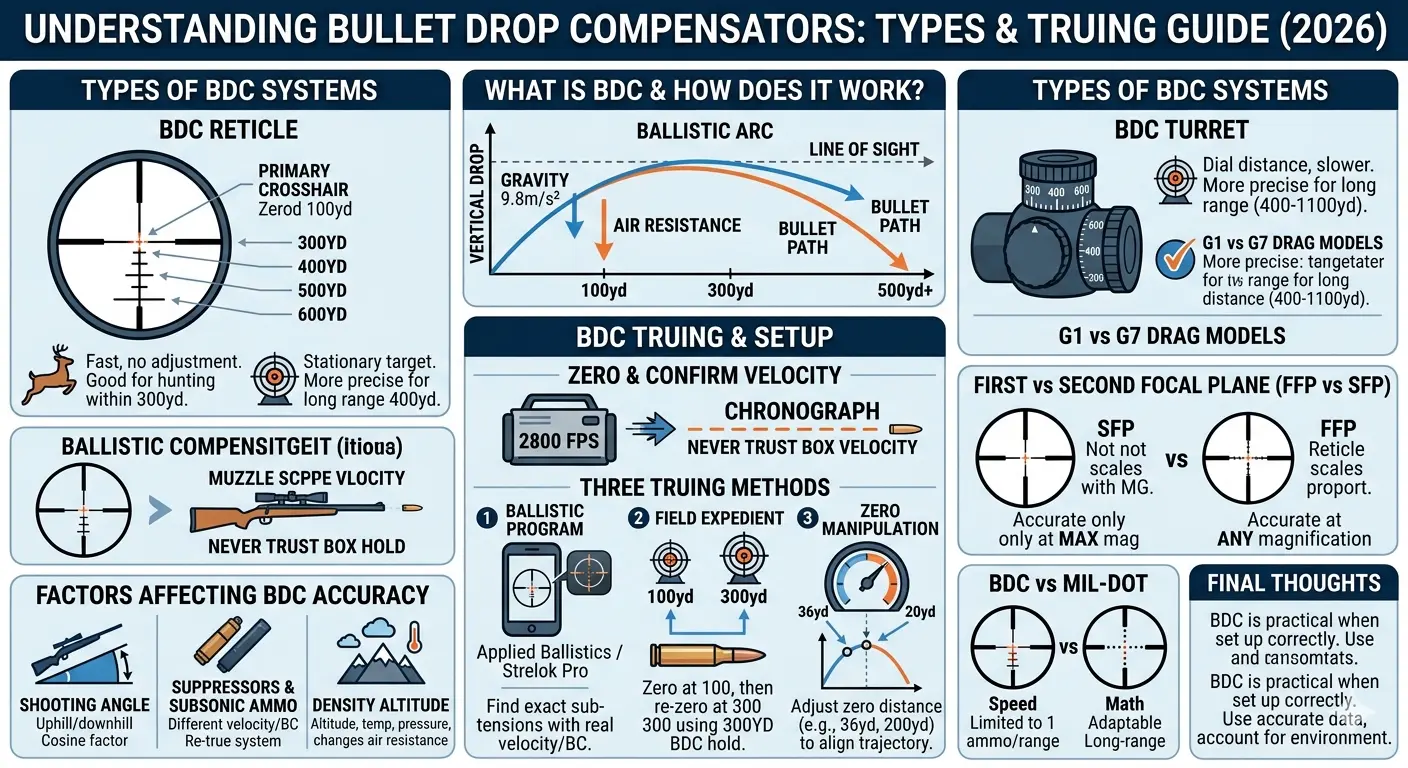
The BDC reticle uses hash marks and holdover points stacked below the primary crosshair along the vertical centerline. Each stadia mark represents pre-calculated bullet drop at a specific distance, typically in 100-yard increments for centerfire rifles. Rimfire BDC scopes use 50-yard increments because rimfire cartridges drop significantly faster at shorter distances.
The BDC turret is a physical elevation turret calibrated in yards rather than standard MOA clicks. You rotate it to display the target distance instead of aiming on a lower stadia mark. BDC turrets are fully cartridge-specific by design. They only produce accurate holdover data when paired with the exact muzzle velocity and ballistic coefficient they were built around.
Here is how they compare practically:
- BDC reticle: fast, no adjustment needed, good for hunting and moving targets within 300 yards
- BDC turret: slower to dial, more precise, better for stationary targets at 400 to 1100 yards
- Both fail when paired with the wrong muzzle velocity or mismatched ammunition
Why Does Bullet Drop Happen and Why Is Compensation Needed?
The moment a bullet leaves the muzzle, gravity acts on it at 9.8m/s acceleration. The bullet does not travel in a straight line. It follows a ballistic arc that bends progressively downward the further it travels. Air resistance reduces velocity over distance, which accelerates the drop effect. The further the target from the muzzle, the greater the vertical displacement below the line of sight.
Two variables determine how steeply that arc curves: ballistic coefficient (BC) and muzzle velocity. A higher BC means less aerodynamic drag and a flatter ballistic trajectory. Higher muzzle velocity gives gravity less time to act before the bullet reaches the target. A BDC reticle calibrated for a specific muzzle velocity and BC produces completely wrong holdover data when either variable changes because of different ammunition or a different barrel length.
G1 vs G7 Drag Models: Why This Matters for BDC Accuracy
G1 drag model BDC turrets were designed for flat-base bullets and overestimate aerodynamic drag at longer ranges, drifting from real bullet drop past 400 to 600 yards. G7 BDC Turrets use a boat-tail reference and a True Ballistic Profile (TBP) from real chronograph data, maintaining precision from sea level to 15,000 feet. With 20 MOA per revolution and an adjustable zero index stop, they cover 800 to 1100 yards in one rotation. Paired with the G7 BR2 ballistic rangefinder, accurate holdover extends to 1400 yards.
First Focal Plane vs Second Focal Plane BDC Scopes
A first focal plane (FFP) BDC scope scales the reticle proportionally as magnification changes, keeping every stadia mark distance-accurate at any power setting. A second focal plane (SFP) BDC scope keeps the reticle size fixed regardless of magnification. SFP holdover points are only accurate at maximum magnification. Use the scope at half power and every stadia mark now represents a completely different distance than labeled, causing consistent misses at distance.
The rule: if you shoot at variable magnification, choose FFP. If you always shoot at maximum power, SFP works fine.
How to Zero a BDC Scope Correctly
Zero the primary crosshair at 100 yards using the standard zero distance for most centerfire BDC reticles. Once properly zeroed, the lower stadia marks below the crosshair are pre-calibrated to account for bullet drop at each subsequent 100-yard increment downrange.
Before starting, verify actual muzzle velocity with a chronograph. Never trust the velocity printed on the ammunition box. Box velocities are frequently 50 to 150fps lower than actual measured performance. That gap shifts every holdover point to the wrong distance. The chronograph reading is the only number that matters for BDC setup.
Three Methods to True Your BDC Reticle
Zeroing at 100 yards is the starting point. Truing is what actually aligns your bullet drop with the stadia marks built into the reticle. Three validated methods exist and each has a specific situation where it outperforms the others.
Ballistic program truing uses Applied Ballistics or Strelok Pro to find the exact Mil or MOA sub-tension of each stadia mark. Input your ballistic coefficient, muzzle velocity, height over bore, and zero distance. The ballistic software generates a reticle overlay showing where your actual bullet drop lands relative to each hold point. The MK18 with a 10.3-inch barrel produces only 2639fps versus the 2800fps the Trijicon ACOG TA31 was designed for, producing 129.9 inches of drop at 600 yards versus the designed 111.7 inches. This method corrects that discrepancy precisely.
Field expedient truing needs no software. Zero at 100 yards on the crosshair, then re-zero at 300 yards using the 300-yard BDC hold directly. This shifts the ballistic trajectory alignment closer to the stadia marks at 300 to 500 yards. It works best when your ammo closely matches the BDC reticle’s calibration cartridge, such as M193 at 3000fps versus the M855 at 2800fps.
Zero manipulation changes the zero distance from 100 yards to an alternative like 36, 75, or 200 yards. Test each in Strelok Pro’s reticle overlay and select the zero where your specific bullet drops align most precisely across all stadia lines. Best for rifles where barrel length has shifted muzzle velocity significantly from the scope’s design specification.
Does Shooting Uphill or Downhill Change Your BDC Holds?
Yes. When you shoot at a steep uphill or downhill angle, gravity only acts on the horizontal component of the bullet’s path. The effective drop equals flat-ground drop multiplied by the cosine of your shooting angle. At 30 degrees you deal with roughly 87 percent of flat-ground drop. At 45 degrees it falls to about 71 percent. Your calibrated stadia marks were built for flat-ground conditions and overestimate drop at steep angles, causing shots to land high. Always hold lower than your stadia mark indicates when shooting at significant inclines or declines.
How Suppressors and Subsonic Ammo Destroy BDC Calibration
Subsonic ammunition drops muzzle velocity far below the threshold any standard BDC reticle was calibrated for. The resulting ballistic trajectory curves dramatically steeper than the pre-set stadia marks can account for. Every holdover point is wrong. 300 AAC Blackout subsonic through a Trijicon ACOG is a documented example where every BDC hold fails completely across all distances.
Any suppressed rifle running subsonic loads needs complete BDC retruing using ballistic program truing or conversion to a Mil-Dot or MOA reticle system that adjusts mathematically to any muzzle velocity. Using a standard BDC with subsonic ammunition without retruing produces consistent misses with no obvious explanation for the shooter.
How Density Altitude Affects Your BDC Accuracy
Density altitude is not just elevation. It combines temperature, humidity, and barometric pressure into one value representing how dense the air your bullet travels through actually is. A BDC turret validated at sea level on a cold dry day produces different bullet drop results at the same location on a hot humid afternoon because air density has changed. Thinner air creates less drag, making the bullet fly flatter than stadia marks predict and causing shots to land high.
Mountain hunters moving from coastal terrain to high altitude need a True Ballistic Profile or ballistic calculator to account for density altitude shifts. Validating holds at your home range and hunting at significantly different altitude and temperature produces wrong data at every stadia mark distance.
BDC vs Mil-Dot: Which One Should You Choose?
BDC scopes deliver speed within 300 yards when shooting a matched cartridge in stable conditions. Mil-Dot reticles provide precise milliradian measurements for calculating wind speed, range, and bullet drop through math, adapting to any cartridge without recalibration.
BDC removes math in the field but limits you to one cartridge and one set of environmental conditions. Mil-Dot requires math but extends to 1000 yards and beyond regardless of ammo or altitude changes. For hunting within 300 yards BDC wins on speed. For long-range work Mil-Dot wins on flexibility.
How to Read and Use a Bullet Drop Compensator Chart
A bullet drop compensator chart shows vertical drop in inches or MOA at specific distances for a given muzzle velocity, ballistic coefficient, sight height, wind speed, and wind angle. Get your BC from the manufacturer’s website rather than the box. Input all variables into a ballistics trajectory calculator and cross-reference the generated drop chart against your BDC reticle’s stadia mark distances. When they align your setup is tuned. When they do not, choose one of the three truing methods and correct the discrepancy before shooting at distance.
Final Thoughts
A bullet drop compensator is one of the most practical tools in precision shooting when set up correctly for your specific rifle, ammunition, and environment. Confirm your focal plane. True your stadia marks with real chronograph data. Account for density altitude when you change shooting environments. If you run a suppressor or subsonic ammunition, retrue the entire system from scratch. And understand that uphill and downhill angles change every hold you have validated on flat ground. A BDC built around accurate data delivers repeatable results at distance. One built on box-printed assumptions gives you false confidence where it matters most.
FAQs
What does BDC stand for on a scope?
BDC stands for bullet drop compensator. On a scope it refers to either a BDC reticle with pre-set holdover marks below the crosshair, or a BDC turret you dial to a yard distance. Both compensate for bullet drop from gravity without requiring manual MOA or Mil calculations during a shot.
Can I use a BDC scope with any ammo?
No. Every BDC reticle and BDC turret is calibrated to a specific muzzle velocity and ballistic coefficient. Using different ammunition shifts every stadia mark to the wrong distance. Always confirm actual muzzle velocity with a chronograph. Box-printed velocities are frequently inaccurate and that discrepancy grows larger in its effect on holdover accuracy with every additional 100 yards of range.
Why is my BDC not matching my actual bullet drop at distance?
The five most common causes are: mismatched muzzle velocity between your ammo and the reticle calibration; wrong zero distance; using an SFP BDC scope at less than maximum magnification; significant density altitude differences from calibration conditions; and barrel length reducing muzzle velocity below the BDC turret’s threshold. Use a chronograph and Strelok Pro or Applied Ballistics to identify which factor is causing the error before attempting any correction.
How accurate is a BDC scope at 500 yards?
A properly trued BDC scope matched to the correct cartridge and muzzle velocity can maintain consistent minute-of-angle accuracy at 500 yards in stable conditions. G1 drag model BDC turrets lose precision past 400 to 600 yards. G7 BDC Turrets built around a True Ballistic Profile maintain greater accuracy through 800 to 1100 yards. Environmental changes including density altitude and shooting angle affect accuracy at any distance regardless of turret type.
Is BDC or Mil-Dot better for long range hunting?
Mil-Dot is the stronger system for serious long-range hunting past 500 yards. It adapts to any cartridge, muzzle velocity, shooting angle, and density altitude through math. BDC works well for fast shots within 300 yards using a matched cartridge in consistent conditions but becomes a liability when any variable changes significantly from calibration conditions. Hunters who move between different elevations and climates benefit from learning Mil adjustments rather than trusting pre-set BDC stadia marks that may no longer match their real-world bullet drop.
What ballistic software should I use to true my BDC reticle?
Applied Ballistics and Strelok Pro are the two most validated tools for BDC reticle truing. Both accept inputs for ballistic coefficient, muzzle velocity, sight height, zero distance, and density altitude and generate a reticle overlay showing how your actual bullet drop aligns with each stadia mark. Always input chronograph-verified muzzle velocity rather than box-printed values. The overlay comparison is only as accurate as the velocity data you feed it.