Does a Charging Phone Emit Radiation? The Science, Real Risks and What to Do (2026)
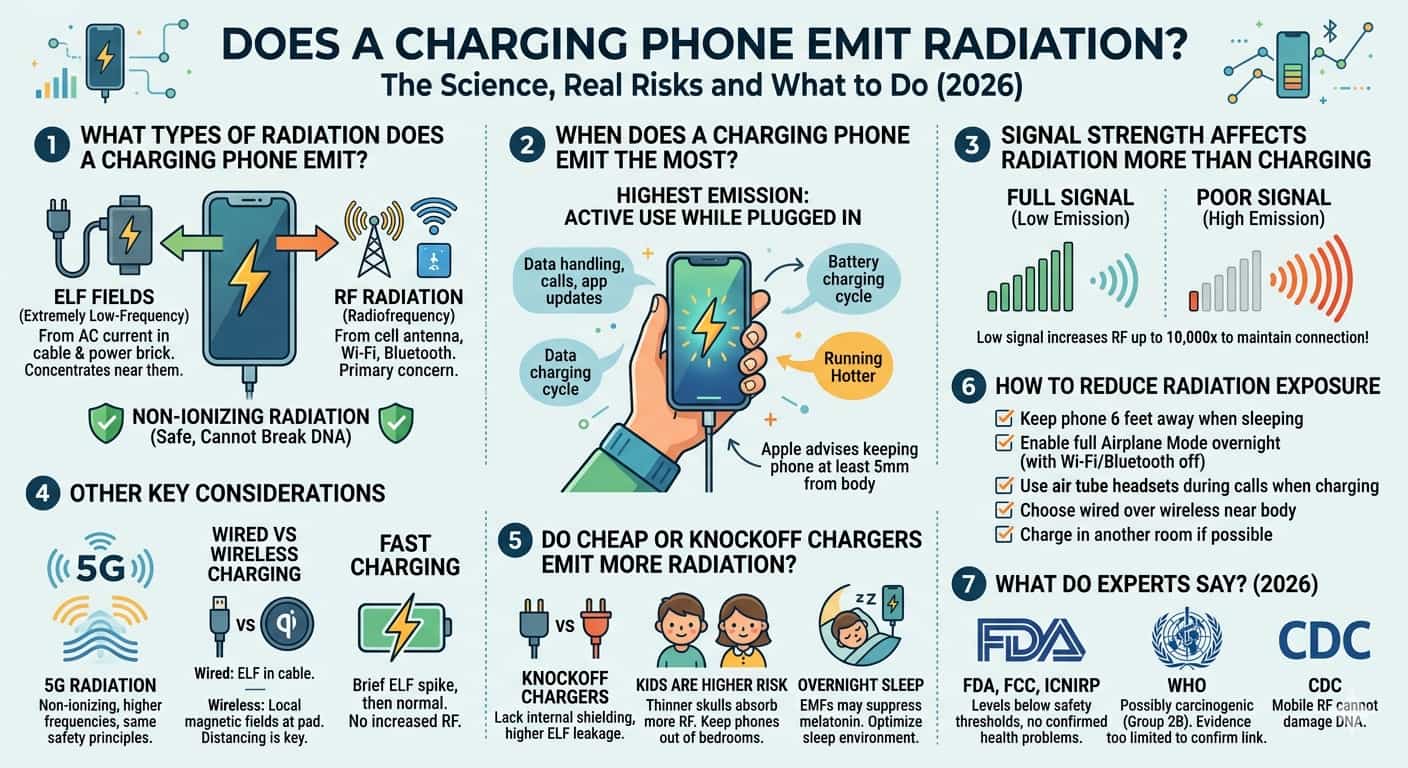
Yes, a charging phone emits radiation. It produces two distinct types of electromagnetic fields (EMFs): extremely low-frequency (ELF) fields from the electrical current flowing through the cable and power brick, and radiofrequency radiation (RF radiation) from active Wi-Fi, Bluetooth, and cellular connections. Both are forms of non-ionizing radiation, meaning they lack the energy to break DNA or damage cells directly.
Most people focus on whether their phone emits radiation while charging but miss the bigger question: when does it emit the most and what can you actually do about it?
What Types of Radiation Does a Charging Phone Emit?
A charging phone emits two completely separate radiation types operating on different parts of the electromagnetic spectrum, and understanding the difference matters for choosing the right response.
ELF fields (extremely low-frequency): These come from the alternating current (AC) flowing through the charging cable and undergoing AC to DC conversion inside the power brick. The ELF field concentrates near the cable and adapter itself.
RF radiation (radiofrequency): This comes from the phone’s cellular antenna, Wi-Fi, and Bluetooth radios managing network connections and syncing data. RF radiation is the primary concern for health researchers because it travels further and is emitted directly from the device you hold.
When a phone charges in standby, RF radiation levels are relatively low. When the phone is active during charging, both ELF fields and RF radiation overlap and the total electromagnetic environment around the device intensifies significantly.
When Does a Charging Phone Emit the Most Radiation?
The single highest-emission state for any smartphone is active use while plugged in.
When you use your phone while it charges, the battery management system cycles electrical current to the battery while the cellular antenna simultaneously handles data, calls, and app updates. The processor manages thermal load, running hotter than normal, and the phone communicates more frequently with nearby cell towers to maintain signal stability during charging cycles. Background app refresh, cloud syncing, and photo uploads layer on top of all this activity, keeping RF radiation elevated well above standby levels.
This combination, active data use plus electrical charging, is why Apple advises users to carry the iPhone at least 5mm from their body during use. The concern is not charging alone. The concern is holding an active transmitter while it is also tethered to a live power source.
How Signal Strength Affects Radiation More Than Charging State
Here is what most people never hear: network signal strength affects RF radiation output far more dramatically than whether or not the phone is charging.
Research from the California Department of Health found that RF radiation in areas of low network signal can be up to 10,000 times higher than in areas of strong signal. When a charging phone sits in a basement, an elevator, or a rural location with poor reception, the cellular antenna boosts its transmit power to maintain connection. That signal-driven spike in radiation dwarfs any increase attributable to the charging process itself.
Does a 5G Phone Emit More Radiation While Charging?
A 5G phone uses beamforming and dynamic spectrum switching that may temporarily amplify its signal output on certain frequency bands to maintain speeds. 5G operates at frequencies up to 80 GHz compared to the 0.7 to 2.7 GHz range of 2G through 4G. However, all 5G frequencies remain in the non-ionizing portion of the electromagnetic spectrum. The National Cancer Institute confirms these frequencies carry too little energy to damage DNA. The same distance-based precautions that apply to 4G charging apply equally to 5G.
Wired vs Wireless Charging: Which Produces More Radiation?
Wireless charging and wired charging produce different EMF types rather than simply more or less radiation overall.
Inductive charging via the Qi charging standard creates a near-field magnetic field between inductive coils at the pad surface. This field drops off sharply with distance. Wired charging generates ELF fields confined primarily to the charging cable and power brick. A wireless charging pad sitting near your head on a nightstand produces higher localized near-field magnetic field exposure than a charging cable attached to a phone across the room.
Misaligned Qi coils temporarily intensify the near-field field during power negotiation until an efficient transfer locks in. Wireless charging also runs hotter due to energy conversion loss.
Does Fast Charging Increase EMF Exposure?
Fast charging briefly spikes ELF fields near the cable and power brick during the initial power negotiation phase. Once the phone settles into stable charging, ELF field levels return to normal. Fast charging does not directly increase RF radiation. The cellular antenna’s activity remains governed by network signal strength and data transfer demand, not by charging wattage.
What the WHO, FDA, and FCC Say About Charging Phone Radiation
The FDA states that over 30 years of scientific evidence has not linked cell phone RF radiation to confirmed health problems. The FCC and ICNIRP confirm that charging-related EMF levels remain far below established safety thresholds under normal use. The CDC confirms that mobile phone RF radiation differs fundamentally from ionizing radiation used in X-rays and lacks the energy to damage DNA.
The WHO classified RF electromagnetic fields as “possibly carcinogenic to humans” (Group 2B) in 2011. This classification does not mean phone radiation causes cancer. It means evidence is currently too limited to confirm or rule out a causal link definitively.
Can Charging Phone Radiation Disrupt Sleep and Melatonin Production?
Research suggests the pineal gland, which regulates the sleep-wake cycle, is sensitive to electromagnetic field exposure. Studies have found that EMF exposure during sleep hours may suppress melatonin production and disrupt circadian rhythms. A charging phone near the bed represents continuous ELF and RF exposure during the body’s natural recovery period. This is why sleep environment optimization matters even when the safety evidence at typical exposure levels is not conclusive.
Does Chronic EMF Exposure Affect Cellular Biology?
A 2002 study found that chronic electromagnetic field exposure reduced HSP70 (Heat Shock Protein 70) levels by 27 percent, weakening cellular stress protection. The NIEHS continues examining cumulative RF exposure effects on biological systems. Mainstream science considers current exposure levels within safe regulatory limits, but proximity reduction remains a reasonable precaution given ongoing research.
Are Children at Higher Risk from a Nearby Charging Phone?
Yes. Children’s skulls are thinner and their developing brain tissue absorbs proportionally more RF radiation than adult tissue. The IARC and independent researchers note that non-ionizing radiation penetrates deeper into children’s heads relative to skull thickness. Keeping charging phones out of children’s bedrooms during sleep reduces both RF radiation and ELF field exposure during the critical developmental hours when the body repairs tissue.
Is a Bedroom Full of Charging Devices a Compounded EMF Problem?
Yes. When a phone, tablet, laptop, smartwatch, and smart speaker charge simultaneously near a sleeping person, their ELF fields and RF radiation overlap and interact. Overlapping EMFs can form localized EMF hotspots around a nightstand through resonance and interference. This compounded background EMF environment across 7 to 8 hours of sleep differs significantly from single-device exposure and warrants strategic device placement across the whole room rather than managing one device at a time.
Does Airplane Mode Actually Reduce Radiation While Charging?
Yes, but the degree of reduction depends on which radios you turn off.
- Turn off Wi-Fi only: eliminates Wi-Fi RF emissions but leaves cellular and Bluetooth active and transmitting throughout the charge cycle
- Turn off Bluetooth only: removes one radio source but leaves cellular and Wi-Fi both transmitting
- Full airplane mode with Wi-Fi and Bluetooth manually turned off: stops virtually all RF radiation while charging, leaving only ELF fields from the cable and power brick
Full airplane mode is the most effective single setting change for reducing charging phone radiation exposure during sleep. Alarms still function in this mode.
What Is Electromagnetic Hypersensitivity and Should You Take It Seriously?
Electromagnetic hypersensitivity (EHS) is a documented condition where people experience headaches, fatigue, insomnia, and skin tingling they attribute to EMF sources including charging phones. WHO reviews have not confirmed a direct causal link between EMF exposure and EHS symptoms at regulatory-compliant levels. The symptoms are real regardless of their cause. The precautionary principle supports reducing unnecessary charging phone proximity for anyone experiencing persistent symptoms near charging devices.
How to Reduce Radiation Exposure from a Charging Phone
Five steps reduce charging phone EMF exposure without giving up your device:
- Keep the phone at least 6 feet from your body while sleeping per Dr. Devra Davis of the Environmental Health Trust
- Enable full airplane mode with Wi-Fi and Bluetooth off before charging overnight
- Use air tube headsets instead of holding the phone to your head during calls while it is plugged in
- Choose wired charging over a wireless charging pad when the pad would sit near your body overnight
- Disable background app refresh to reduce antenna activity during charge cycles
Should You Charge Your Phone in a Different Room Overnight?
Yes, and it is the simplest high-impact change available. Charging in another room removes both ELF fields from the cable and power brick and RF radiation from cellular, Wi-Fi, and Bluetooth simultaneously. It costs nothing, requires no product, and eliminates proximity-based exposure entirely during the 7 to 8 hours of sleep when the body is most vulnerable.
Do Cheap or Knockoff Chargers Emit More Radiation?
Yes. Knockoff chargers lack the internal shielding and voltage regulation quality of certified chargers, causing higher ELF field leakage through poorly insulated cables and adapters. Research from Swinburne University confirms any cable connected to mains voltage will cause a voltage sensor to respond, and knockoff chargers intensify this effect. Always use certified chargers and shielded cables to minimize stray EMF output from the charging setup itself.
Final Thoughts
Does a charging phone emit radiation? Yes, in two distinct forms. ELF fields from the cable and power brick, and RF radiation from active wireless connections. Neither type at typical exposure levels is classified as an established health hazard by the FDA, FCC, or ICNIRP. But the most practical approach in 2026 is straightforward: charge in another room, use full airplane mode overnight, and keep children’s bedrooms phone-free while charging. The radiation does not disappear, but distance and simple settings eliminate the proximity exposure that actually matters.
FAQs
Is it safe to sleep next to a charging phone?
It is not classified as dangerous by FCC or ICNIRP safety standards. However proximity during sleep extends ELF and RF exposure across 7 to 8 hours. Dr. Devra Davis recommends keeping phones at least 6 feet from the body during sleep. Charging in another room eliminates all proximity exposure and is the simplest evidence-informed choice for better sleep hygiene.
Does charging overnight increase radiation exposure?
Overnight charging does not increase EMF intensity but extends exposure duration. Once the battery reaches full charge, most phones reduce cellular antenna activity and background app refresh, lowering RF radiation output. The concern is not radiation intensity but cumulative exposure across hours near the sleeping body, which distance or airplane mode effectively addresses.
Does wireless charging produce more radiation than wired charging?
Wireless charging via inductive coils produces a stronger near-field magnetic field at the pad surface than the ELF fields from a wired cable. The near-field field from Qi charging drops off extremely rapidly with distance. Direct body contact with a wireless charging pad presents higher localized exposure than a charging cable running to a phone on a distant surface.
Can charging phone radiation disrupt sleep?
Research suggests the pineal gland is sensitive to electromagnetic fields and that EMF exposure during sleep hours may suppress melatonin production and disrupt circadian rhythms. Evidence at typical exposure levels is not conclusive, but the precautionary principle supports charging outside the bedroom to support undisrupted sleep cycles.
Is it safe to use a phone while charging?
Using a phone while charging places it in its highest emission state because RF radiation rises as the cellular antenna handles data while the battery management system cycles charge simultaneously. Apple advises at least 5mm of distance during use. Use speakerphone or air tube headsets and place the phone on a surface rather than holding it pressed against your body while plugged in.
Does airplane mode stop all radiation from a charging phone?
Full airplane mode with Wi-Fi and Bluetooth manually off stops virtually all RF radiation while charging. It does not eliminate ELF fields from the charging cable and power brick, which remain active regardless of software settings. For maximum overnight exposure reduction, combine airplane mode with placing the phone at a distance from the body or charging in another room entirely.