What Is Mechanical Engineering Technology? Careers, Degrees and Salary in 2026
Mechanical engineering technology is an applied engineering field that trains graduates to design, develop, maintain, and troubleshoot mechanical systems and equipment. It sits between a traditional engineering degree and a skilled trade, making it one of the most practical and employable paths available in 2026. If you are trying to decide whether this career is worth your time and money, keep reading.
What Does a Mechanical Engineering Technician Actually Do?
A mechanical engineering technician works alongside engineers to keep industrial systems running. On a typical day, that includes:
- Creating technical drawings using Computer-Aided Design (CAD) software
- Operating and programming CNC machine tools
- Testing and inspecting mechanical equipment for quality and performance
- Troubleshooting electromechanical systems on the production floor
- Supporting production process planning and recording data for engineering teams
This is not a desk job. Technicians work in labs, manufacturing plants, research facilities, and on industrial sites. The role demands mechanical aptitude, attention to detail, and fast problem-solving under real pressure.
What Do You Study in a Mechanical Engineering Technology Program?
The curriculum is built around real-world application. Here is what core coursework typically covers:
- Thermodynamics and heat transfer
- Fluid mechanics and fluid power automation
- Machine design and applied mechanics
- Statics and strength of materials
- Electrical circuits and electromechanical systems
- Manufacturing processes and engineering materials
- Computer-aided drafting and instrumentation
- Robotics and programmable controllers
Programs are heavily lab-based. Hands-on lab training runs alongside theory so graduates can contribute on day one of their career, not after months of adjustment.
What Is the Mechatronics Track in an MET Program?
The mechatronics track blends mechanical systems with electronics and automation. Students study fluid power automation, programmable logic controllers (PLC), electromechanical systems integration, and electrical circuit troubleshooting.
This specialization is gaining serious traction in 2026. Manufacturers adopting collaborative robotics and AI-driven production lines actively recruit technicians with mechatronics training. If you plan to work in advanced manufacturing or automation, this track deserves serious consideration.
What Degree Levels Are Available in Mechanical Engineering Technology?
Associate of Applied Science (A.A.S.): Two years. Covers foundational technical skills and qualifies you for entry-level technician roles. Many programs have articulation agreements that protect your credits when you transfer to a four-year degree.
Bachelor of Science in MET: Four years total, or two additional years if you start with an A.A.S. Opens doors to production engineer, design engineer, and project manager roles with a stronger salary ceiling.
Master of Science in Mechanical Engineering: Two years post-bachelor’s. Focuses on research, advanced specialization, and leadership in engineering teams.
Most students start with the A.A.S. because it gets them into the workforce fast. They then use articulation agreements to build toward a B.S. without losing prior credits.
| Degree | Duration | Career Entry | Transfer Path |
| A.A.S. MET | 2 years | Mechanical Technician | Yes, via articulation |
| B.S. MET | 4 years | Production/Design Engineer | Graduate school eligible |
| M.S. ME | 2 years post-B.S. | Senior Engineer / R&D | Ph.D. pathway |
What Jobs Can You Get With an MET Degree?
MET graduates work across a wide range of technical and engineering-adjacent roles. Common entry-level positions include CAD technician, manufacturing technician, quality control technician, field service technician, and engineering technician.
With experience and a B.S. MET, you can advance into automation engineer, production engineer, mechanical designer, project manager, and engineering sales representative roles. The career path rewards skill-building and continued education. It is not a ceiling, it is a launch pad.
What Industries Hire the Most Mechanical EngineeringTechnicians in 2026?
Demand is strong across multiple sectors:
- Manufacturing remains the largest employer
- Aerospace needs technicians for quality control and system testing
- Automotive and electric vehicle manufacturing are growing rapidly
- Renewable energy systems including solar and wind are creating new technical roles
- Rail vehicle engineering and transportation infrastructure
- AI-driven manufacturing facilities hiring for automation support
- Government agencies, research labs, and consulting engineering firms
The electric vehicle and renewable energy boom is generating particularly strong demand in 2026 for technicians with electromechanical systems backgrounds.
What Is the Salary of a Mechanical Engineering Technician in 2026?
Salary depends on your degree level, experience, and industry. Here is a realistic breakdown:
| Role | Degree | Industry | Avg. Salary |
| Manufacturing Technician | A.A.S. | Manufacturing | $48,000 – $58,000 |
| Quality Control Technician | A.A.S./B.S. | Automotive | $52,000 – $67,000 |
| Automation Engineer | B.S. MET | AI Manufacturing | $68,000 – $82,000 |
| Production Engineer | B.S. MET | Aerospace/Energy | $72,000 – $88,000 |
Technicians in aerospace, energy systems engineering, and autonomous vehicle manufacturing earn at the top of this range. A B.S. MET raises your salary ceiling well above the A.A.S. entry point, making the additional two years a worthwhile investment for most people.
What Certifications Should an MET Graduate Get?
Your degree gets you in the door. Certifications make you stand out. The most valuable credentials in 2026 are:
- SolidWorks Certified Professional (CSWP): Highest employer recognition for CAD competency
- Certified Manufacturing Technologist (CMT): Signals production floor credibility
- Certified Quality Technician (CQT): Valuable in manufacturing and aerospace QA roles
- PLC Programming Certification: Essential for mechatronics and automation positions
- AWS Welding Certification: Adds employability in fabrication environments
Build your certification roadmap this way: confirm ABET accreditation first, earn your CSWP after completing CAD coursework, then stack CMT or CQT based on your target industry, and add PLC certification if automation is your goal.
Can You Take the PE Exam With an MET Degree?
This is the question most competitors skip, and it is one of the most important things a prospective MET student needs to know before enrolling.
The short answer: it depends on your state.
Some states allow graduates of ABET-accredited MET programs to sit the Fundamentals of Engineering (FE) exam and eventually pursue the Professional Engineer (PE) exam. Others limit PE exam eligibility to holders of a traditional B.S. in Mechanical Engineering.
Check your state engineering board’s requirements directly before you enroll. If PE licensure is a career goal, this step is non-negotiable.
What Is ABET Accreditation and Why Does It Matter?
ABET accreditation is a globally recognized quality standard for engineering technology programs. For MET graduates, it matters for three specific reasons:
- PE exam eligibility: Many states require ABET accreditation as a baseline condition
- Employer recognition: Engineering firms and government agencies often require it when hiring
- Credit transfer: Universities are far more likely to accept transfer credits from ABET-accredited programs
Always verify ABET status before enrolling in any mechanical engineering technology program, online or on-campus.
What Is the Difference Between Mechanical Engineering
and Mechanical Engineering Technology?
This is the most searched question in this topic, and competitors handle it poorly. Here is the honest breakdown.
Mechanical Engineering (ME) focuses on theoretical design, advanced mathematics, and engineering science. ME graduates pursue PE licensure and move into design, research, and systems engineering roles.
Mechanical Engineering Technology (MET) focuses on applied skills, hands-on technical training, and real-world production work. MET graduates enter the workforce faster in technician, quality control, and manufacturing support roles.
| Factor | ME | MET |
| Core Focus | Theoretical + Research | Applied + Practical |
| Math Level | Advanced calculus | Applied calculus |
| PE Exam | Full access (all states) | Varies by state + ABET |
| Entry Role | Design Engineer | Manufacturing Technician |
| Time to Employment | 4+ years | 2 years (A.A.S.) |
Neither path is better in every situation. ME fits those who want deep design and research careers. MET fits those who want faster employment and applied technical work.
How Is AI and Automation Changing the MET Role in 2026?
The mechanical engineering technician role looked very different five years ago. In 2026, technicians work alongside digital twin systems, monitor AI-generated maintenance alerts, and support production lines running collaborative robotics.
Key shifts happening right now:
- Digital twin implementation: Technicians collect real-world sensor data and validate it against digital model outputs
- Condition-based maintenance: AI flags problems before failure; technicians carry out the fix
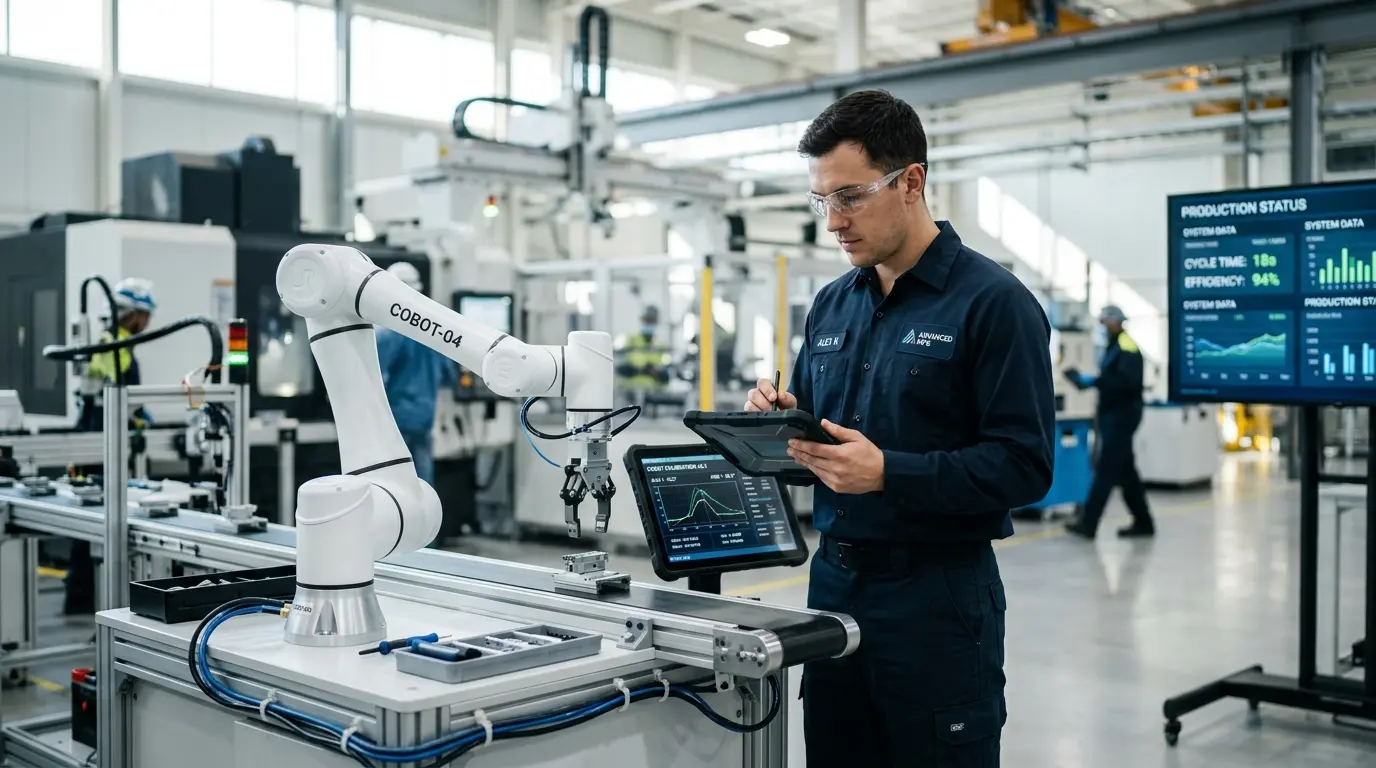
- Collaborative robotics (cobots): Technicians program, monitor, and maintain cobot systems on production floors
- Predictive maintenance: Machine learning reduces reactive shutdowns and requires technicians to interpret data, not just repair parts
MET graduates with mechatronics and electromechanical systems skills are the most future-proof in this market. The technician who understands both the physical system and the data layer is the one employers compete to hire.
Can You Earn an MET Degree Online or Part-Time?
Yes. Several ABET-accredited universities now offer mechanical engineering technology programs through online and hybrid formats built for working adults and career-changers.
Online programs cover the same core curriculum: CAD, thermodynamics, fluid mechanics, and manufacturing processes with flexible scheduling. Lab components are typically handled through regional partnerships or scheduled intensives.
Verify two things before enrolling: ABET accreditation status and your state’s PE exam eligibility rules for online program graduates.
How Do Articulation Agreements Work for MET Graduates?
Articulation agreements are formal transfer partnerships between community colleges and four-year universities. They protect your associate degree investment by guaranteeing that a defined number of credits transfer directly toward a bachelor’s program.
In practical terms: MET graduates with an A.A.S. can transfer up to 76 of the 127 total credit hours required for a B.S., completing the degree in approximately two additional years. This two-plus-two pathway is one of the most cost-effective routes in engineering education.
Final Thoughts
Mechanical engineering technology is one of the most versatile and employment-ready technical degrees available in 2026. Whether you are starting fresh, switching careers, or building from an associate degree toward a bachelor’s, MET offers a clear path forward at every stage.
Choose an ABET-accredited program, stack relevant industry certifications, understand your state’s PE exam rules, and pay attention to the growing role of AI, digital twins, and collaborative robotics in the daily work. The mechanical engineering technology graduates who adapt to these shifts now will carry the strongest career advantages for the next decade.
FAQs
Is mechanical engineering technology a good career?
Yes. Strong demand in manufacturing, aerospace, electric vehicle production, and renewable energy makes MET a solid career in 2026. With a B.S. MET and relevant certifications, earnings reach $80,000 and above in competitive sectors.
Is mechanical engineering technology hard?
It requires solid math and mechanical aptitude but is more applied and less theoretical than a traditional ME degree. Most students find the hands-on lab format more engaging than pure classroom learning.
Can a mechanical engineering technician become a licensed engineer?
With a B.S. MET, experience, and PE licensure where your state allows it, yes. Many MET graduates advance into production engineer, design engineer, and project manager roles over time.
What math do you need for mechanical engineering technology?
Applied calculus, algebra, trigonometry, and physics form the foundation. It is more practical and less abstract than the differential equations required in a traditional ME program.
What does a mechanical engineering technician do in manufacturing?
They assist engineers in designing tools and parts, operate and program CNC machines, inspect product quality, record production data, and troubleshoot mechanical and electromechanical equipment during manufacturing runs.
How long does it take to become a mechanical engineering technician?
Two years for an A.A.S. degree. Four years total for a B.S. MET, or two additional years for A.A.S. graduates using articulation agreements.
What is the career growth path from technician to engineer?
MET graduates typically start as technicians, then advance with experience and a B.S. MET into production engineer, design engineer, or project manager roles. PE licensure where accessible opens senior engineering and management positions.