SEO for Tech Companies: The Complete 2026 Guide to AI Search Visibility
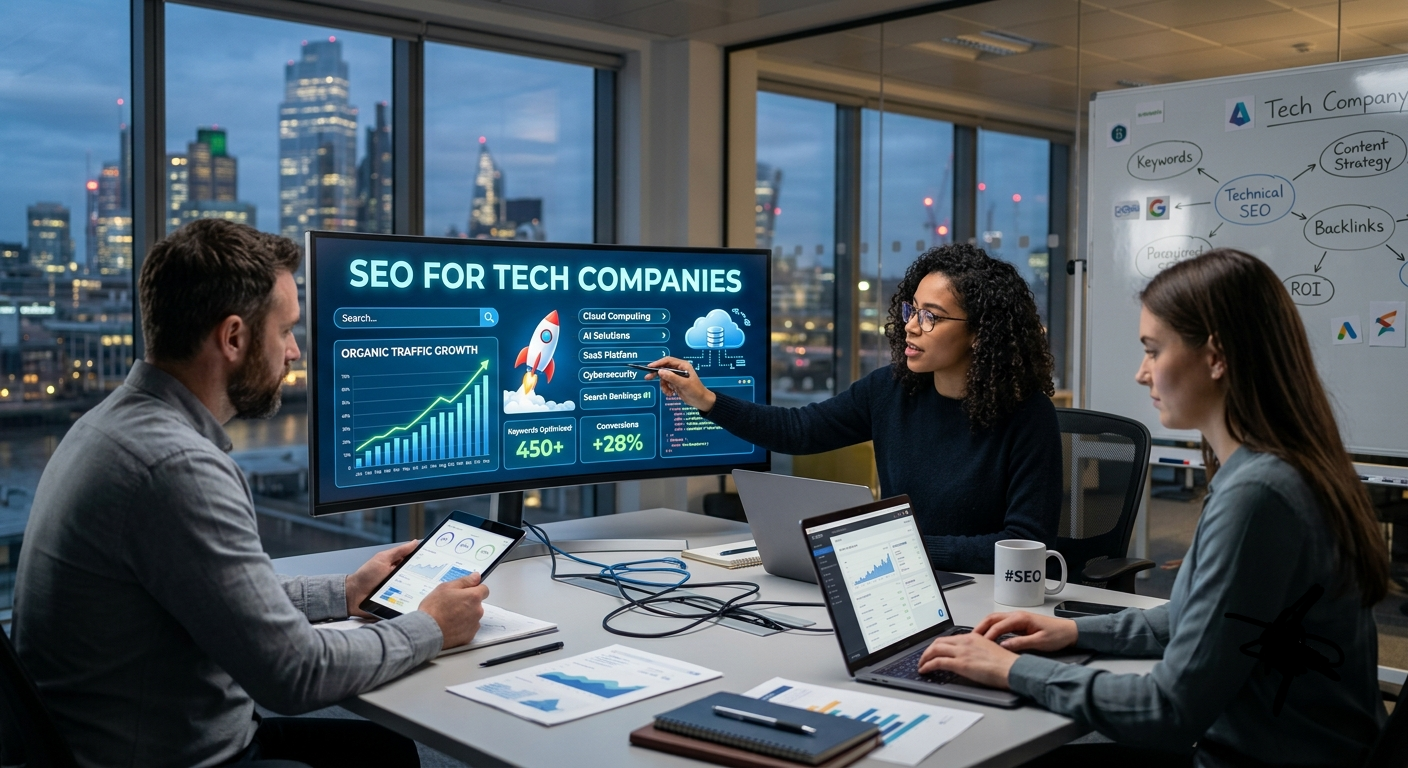
SEO for tech companies is the practice of optimizing software and technology websites through technical SEO, on-page SEO, and off-page SEO so they rank in organic search and AI Overviews. It connects every stage of the tech buyer journey to content, turning research-stage visibility into qualified leads instead of wasted traffic.
If you have read conflicting headlines about whether SEO still works now that AI Overviews and zero-click search are everywhere, you are not alone. The truth is simpler than it sounds. Let’s walk through what actually moves the needle in 2026.
What Is SEO for Tech Companies?
SEO for tech companies blends technical SEO, on-page SEO, and off-page SEO to help software and technology websites rank in both traditional search and AI-driven results. It connects content to buyer intent so the right person finds the right page at the right stage of their research.
Organic search generates 44.6% of all B2B revenue and delivers a strong average ROI for B2B SaaS companies, ahead of paid, email, and social combined. Tech buyers research heavily before talking to sales, so visibility decides who makes the shortlist long before a demo gets booked.
What Is the Difference Between SEO and PPC for Tech Companies?
SEO builds organic search visibility that compounds through content marketing and link building, while PPC only delivers traffic as long as you keep paying for clicks. SaaS SEO typically produces a lower cost per lead than paid search, making it the stronger long term customer acquisition cost channel.
What Is GEO and How Is It Different From SEO?
Generative Engine Optimization (GEO) optimizes content to be cited by AI platforms like ChatGPT and Perplexity, while traditional SEO focuses on ranking positions in Google. Related disciplines include Chat Engine Optimization for conversational AI systems and Language Model Optimization, which addresses how language models process content.
What Is AI Share of Voice?
AI share of voice is the percentage of buyer-intent queries where your brand gets cited inside AI-generated responses, tracked through citation frequency. It is becoming the key 2026 metric separating tech companies gaining ground in AI search from those losing visibility to zero-click search.
How Does the Tech Buyer Journey Shape SEO Strategy?
A strong tech SEO strategy maps content to the tech buyer journey using buyer persona development and an Ideal Customer Profile to identify what each stage actually needs. Early content addresses problems, mid-stage content explains capabilities, and late-stage content covers evaluation criteria buyers compare before deciding.
What Is Technical SEO for Software Companies?
Technical SEO for software companies covers crawl efficiency, index quality, and site architecture so search engines and AI agents can interpret complex, dynamic sites without friction. Core Web Vitals, including Largest Contentful Paint, Interaction to Next Paint, and Cumulative Layout Shift, affect both rankings and AI citation eligibility.
How Do You Build Topical Authority in Tech Markets?
Topical authority comes from organizing content into topic clusters built around a central pillar page, with cluster pages covering narrower parts of the same theme. Semantic SEO reinforces this by naturally including related terms and long-tail keywords instead of repeating one target keyword over and over.
What Is E-E-A-T and Why Does It Matter for Tech SEO?
E-E-A-T stands for Experience, Expertise, Authoritativeness, and Trustworthiness, the framework search engines and AI systems use to judge content credibility. Tech companies need real authorship, original research, and proprietary data here, since AI tools will not cite content that simply repackages information they can already generate themselves.
What Schema Markup Should a SaaS Company Use?
SaaS companies benefit most from SoftwareApplication schema for products, Article schema for blog content, and Organization schema using JSON-LD format for company details. These structured data types help both search engines and AI agents accurately interpret pricing, authorship, and product information without misreading your intent.
Does FAQ Schema Still Help With Featured Snippets in 2026?
No, not the way it used to. Google removed FAQ rich results from Search in May 2026, so FAQPage schema no longer earns the snippet placement many tech companies still chase. It can still help AI systems parse Q&A content, just don’t treat it as a featured snippet tactic anymore.
How Do You Get a Tech Company Cited in ChatGPT or Perplexity?
Getting cited requires content built for query fan-out, where AI systems break complex questions into sub-queries your pages should directly answer. Clear headings and concise, self-contained explanations increase citation frequency across AI Overviews, ChatGPT, and Perplexity far more reliably than keyword density ever did.
Does Third-Party Review Platform Presence Affect AI Citations?
Yes. Domains with profiles on platforms like G2, Capterra, and Trustpilot, plus strong Reddit and Quora mention activity, show notably higher odds of being cited by ChatGPT. Building a presence there is now a measurable, controllable part of growing your AI share of voice.
Do I Need an llms.txt File for My SaaS Website?
llms.txt is an emerging standard, a markdown file at your site root that gives AI models a clean, curated map of your most important pages. Major tech companies already ship one. It is not required for AI Overview eligibility, but it is a low-cost, early-mover signal worth adding now.
Should I Block GPTBot or Allow It?
It depends on the bot’s purpose. Training agents like GPTBot, ClaudeBot, and Google-Extended fetch content to train models, while search and answer agents like OAI-SearchBot, Claude-SearchBot, and PerplexityBot retrieve content specifically to cite you. Blocking the wrong category in robots.txt can quietly remove you from AI answers.
Here’s a quick way to think about it:
- Training agents: optional to block, since they don’t drive citations
- Search and answer agents: generally worth allowing, since they directly power citations
- Check your robots.txt regularly, since bot behavior keeps shifting
What Are MCP Servers and the Open Knowledge Format?
MCP servers (Model Context Protocol) and the Open Knowledge Format are emerging AI-ready protocols that give AI agents structured, portable access to your site’s content beyond standard HTML. Pairing these with llms.txt and schema markup positions tech companies ahead of the curve as agentic traffic keeps growing.
How Do AI Agents That Browse and Transact Change SEO?
Agentic traffic refers to AI agents that don’t just retrieve information but actively browse, compare, and complete tasks on a user’s behalf. This shifts technical SEO priorities toward deeper, machine-readable structured data, since these agents need to extract accurate facts rather than simply crawl pages for indexing.
What Link Building Tactics Work for Tech Companies?
Effective tactics include white-hat link building through digital PR and HARO, guest posting on respected industry sites, and reclaiming unlinked brand mentions using tools like BuzzSumo or Brand24. Listings on niche directories, StackShare, and Clutch build authority while signaling topical relevance to both search engines and AI.
Once links are flowing in, audit your backlink profile regularly for toxic backlinks or link farm associations, then submit a disavow file through Google Search Console if needed. Pair this with consistent internal linking so authority spreads cleanly and duplicate or orphaned content doesn’t weaken your structure.
What Is Bottom-Funnel Content for Tech Companies?
Bottom-funnel content includes comparison pages, alternative pages, and integration pages that target buyers actively evaluating solutions rather than casually researching. These pages typically convert at much higher rates than blog content, since visitors searching these terms sit much closer to an actual purchase decision.
Product-led SEO takes this further by turning real product usage patterns and jobs-to-be-done content into searchable topics. Instead of generic feature pages, this creates programmatic SEO assets, like individual integration pages, tied to tasks buyers are genuinely trying to accomplish.
How Do You Measure SEO ROI for a Tech Company?
Measuring SEO ROI means tracking customer acquisition cost, customer lifetime value, and visitor-to-lead conversion rate, not just raw organic traffic volume. Multi-touch attribution and B2B CRO data connect MQLs and SQLs back to specific content, proving exactly how SEO for tech companies contributes to pipeline.
How Do You Connect SEO Intent Data to Outbound Sales?
Track which bottom-funnel pages, like comparison or pricing pages, specific accounts are visiting, then feed that intent data directly to your SDR or AE team. This turns passive SEO traffic into an active signal source, making outbound conversations far more relevant and far better timed.
Should I Hire In-House or Outsource SEO for My Tech Company?
A full in-house team needs a strategist, technical specialist, content writer, and link building coordinator, while outsourcing covers the same scope through one agency retainer. Most growing tech companies save significantly by outsourcing or running a hybrid model instead of building a complete internal team from scratch.
[Comparison Table] In-House vs Outsourced SEO Cost Structure
| Model | What’s Included | Cost Structure |
| In-house team | Strategist, technical specialist, content writer, link coordinator, tools | Full salaries, benefits, payroll tax, tool subscriptions |
| Outsourced agency | Technical SEO, content, link building, reporting | Monthly retainer scaled to company stage |
| Hybrid model | One internal lead plus agency execution | Lower headcount plus partial retainer |
How Much Does SEO Cost for a SaaS Company?
SaaS SEO costs scale with company stage, with early-stage companies spending less monthly than growth-stage or enterprise programs. Tool subscriptions for platforms like Ahrefs, Semrush, or Screaming Frog add to either in-house or outsourced costs no matter which model you choose.
Final Thoughts
SEO for tech companies in 2026 is no longer just about ranking blue links. It’s about technical foundations, real authority, and structured signals that both humans and AI agents can trust. Get your bot access, schema, and content depth right, and you build visibility that works across Google, ChatGPT, and Perplexity at the same time, instead of chasing each one separately.
FAQs
What is SEO for tech companies?
It optimizes software and technology websites through technical, on-page, and off-page SEO to rank in organic search and AI Overviews, turning research-stage visibility into qualified leads.
What is the difference between SEO and PPC for tech companies?
SEO builds compounding visibility through content and links over time, while PPC only delivers traffic for as long as you keep paying for it.
Is SEO worth it for a tech startup?
Yes. Organic search delivers a strong average ROI for B2B SaaS and typically produces a lower customer acquisition cost than paid channels over time.
Should I hire an in-house SEO team or outsource for my tech company?
Most growing tech companies save money and gain broader expertise by outsourcing or using a hybrid model instead of building a full internal team.
Do I need an llms.txt file for my SaaS website?
It’s not required, but it’s a low-cost, early-mover signal that helps AI models understand your most important pages.
Does FAQ schema still help with featured snippets in 2026?
No. Google removed FAQ rich results from Search in May 2026, so FAQPage schema no longer earns featured snippet placement like it used to.
What is AI share of voice and how do I track it?
It’s the percentage of buyer-intent queries where your brand gets cited in AI-generated responses, tracked through citation frequency monitoring.
How is AI changing SEO for tech companies?
AI search has introduced new factors like llms.txt, bot access decisions, and citation tracking, layering on top of traditional SEO rather than replacing it.